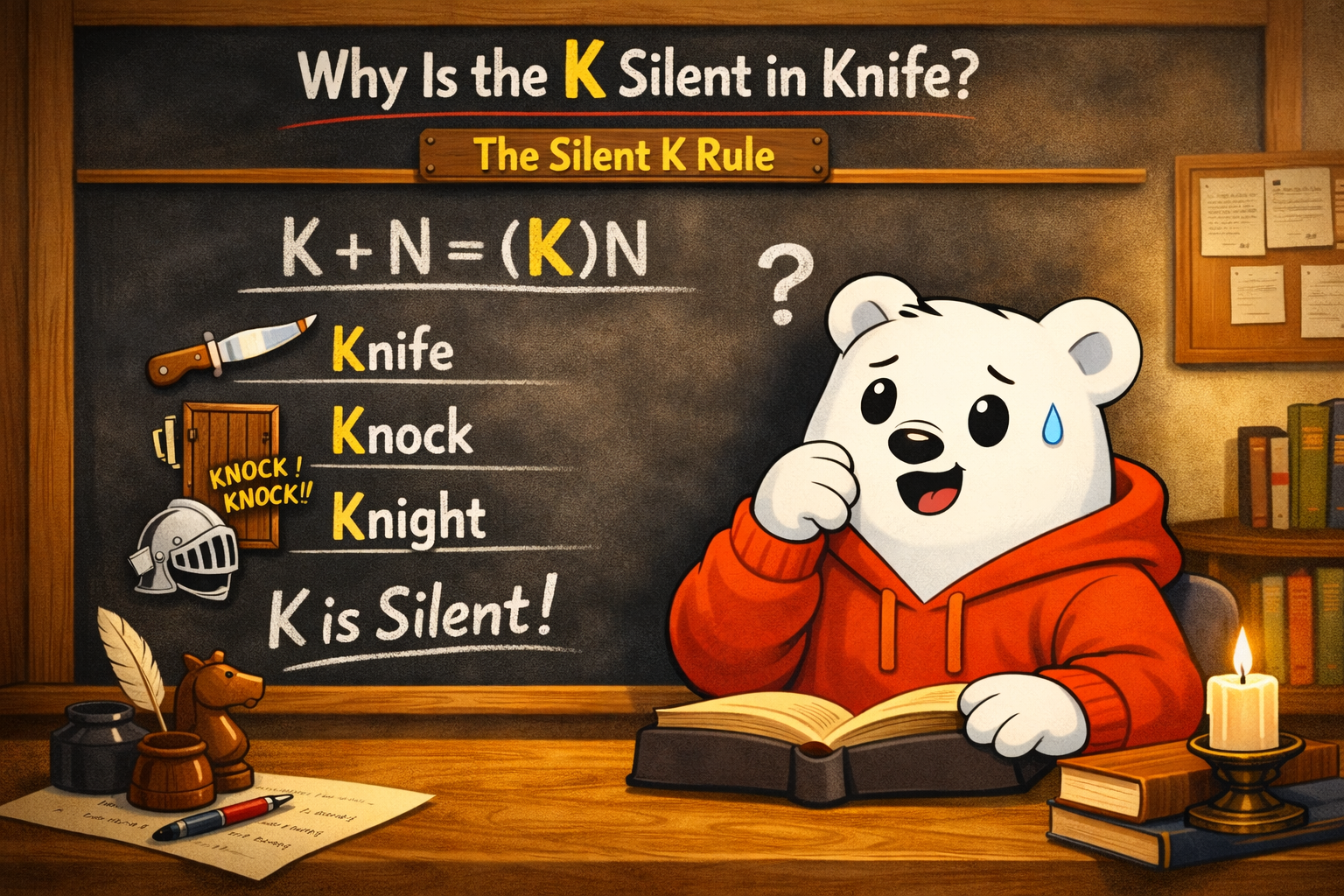
Why Is the K Silent in Knife? The Silent K Rule
English put a K in knife, knee and know, then told you not to say it. Here's why the silent K exists and the full list of words it hides in.
By Chris S · · Pronunciation
Why Is the K Silent in Knife? The Silent K Rule
English wrote a K at the front of knife, knee and know, and then quietly decided you should never say it. If you have ever stared at the word knight and wondered what the K is even doing there, you are asking exactly the right question. This post is for anyone learning English who is tired of letters that sit on the page doing nothing. The silent K looks like a trick, but there is a clean rule behind it, a strange piece of history, and a short list of words where it shows up. Once you see it, you stop tripping on it.
The rule
The rule is almost insultingly simple. When a word starts with K followed by N, the K is silent. You say only the N. Knife sounds like nife. Knee sounds like nee. Know sounds exactly like no. Knock, knot, knuckle and knit all do the same thing. There is no group of common exceptions to memorise and no special case waiting to catch you out. K before N means drop the K. That is the whole rule.
It wasn't always silent
Here is the part that makes it make sense. The K used to be pronounced. In Old English, people really did say k-nife and k-night, with the K clicking at the front, and that pronunciation held on for centuries, into roughly Shakespeare's time. Somewhere around the sixteenth and seventeenth centuries, English speakers stopped saying the K in the kn cluster, most likely because it was simply easier to say only the N. But by then the spelling had already set hard, so the K stayed on the page with nothing left to do. English dropped the sound and kept the letter. Why? Because why not.
If you want proof it was once spoken, look at German, which never dropped it. The German word Knecht is a cousin of knight, and Knoten is a cousin of knot, and in both the K is pronounced out loud.
The words it hides in
The good news is that the list is short and full of everyday words. These are the ones you will actually meet:
knee, kneel, knead, knife, knight, knit, knob, knock, knot, know, knowledge, known, knew, knows, knuckle, knack.
The silent K also creates a set of perfect twins, words that sound identical to other words. Know sounds like no. Knight sounds like night. Knot sounds like not. Knew sounds like new. Knead sounds like need. Knows sounds like nose. You can only tell them apart from the meaning of the sentence, never from the sound.
The mistake that actually costs you
Saying the K out loud by accident is a small slip. The bigger problem is the opposite one. Because you cannot hear the K, it is very easy to forget it when you write, so people type nife, nock or nee and the word looks almost right. The real skill, then, is in your eyes, not your ears. When you read, train yourself to spot the KN at the start, cover the K, and read what is left: knee becomes nee, know becomes no.
It is also worth knowing that K is not the only letter doing this. The G plays the exact same trick before N, which is why gnome, gnaw and sign all carry a silent G. Same ghost, different letter.
Quiz: test yourself
Three short parts, three styles. Answers are at the bottom. No peeking.
Part 1: Fix the spelling. Each word is written the way it sounds. Add the missing silent letter.
nife
nee
nock
nuckle
nit
Part 2: Choose the right word. Pick the spelling that fits the sentence.
I ___ the answer. (know / no)
He is a ___ in shining armour. (knight / night)
Tie the rope in a ___. (knot / not)
I ___ her years ago. (knew / new)
You ___ the dough to make bread. (knead / need)
Part 3: Which letter is silent? Name the silent letter in each word.
knee
gnaw
knock
sign
knife
Answers
Part 1: (1) knife (2) knee (3) knock (4) knuckle (5) knit
Part 2: (6) know (7) knight (8) knot (9) knew (10) knead
Part 3: (11) K (12) G (13) K (14) G (15) K
If you missed any, that is the word to write out a few times this week until the silent letter feels normal.
Common questions
Is the K always silent before N?
At the start of a word, yes. In ordinary English words, KN at the beginning always means a silent K, so you can rely on it.
Why keep a letter you never say?
The spelling froze before the sound disappeared, and changing it now would only cause confusion. The K is what separates know from now and knight from night on the page.
Are there any words where that K is pronounced?
Only a few names and borrowed words, like the surname Knutson. In everyday vocabulary you can safely treat KN as a silent K.
Is it the same for a silent G?
Yes. G before N at the start of a word is also silent, as in gnome, gnat and gnaw.
Now you know
Silent letters get a lot easier when someone shows you the pattern instead of leaving you to guess. So now you know, and yes, that "know" has a silent K too. Why not learn the rest from one of our professionals here?