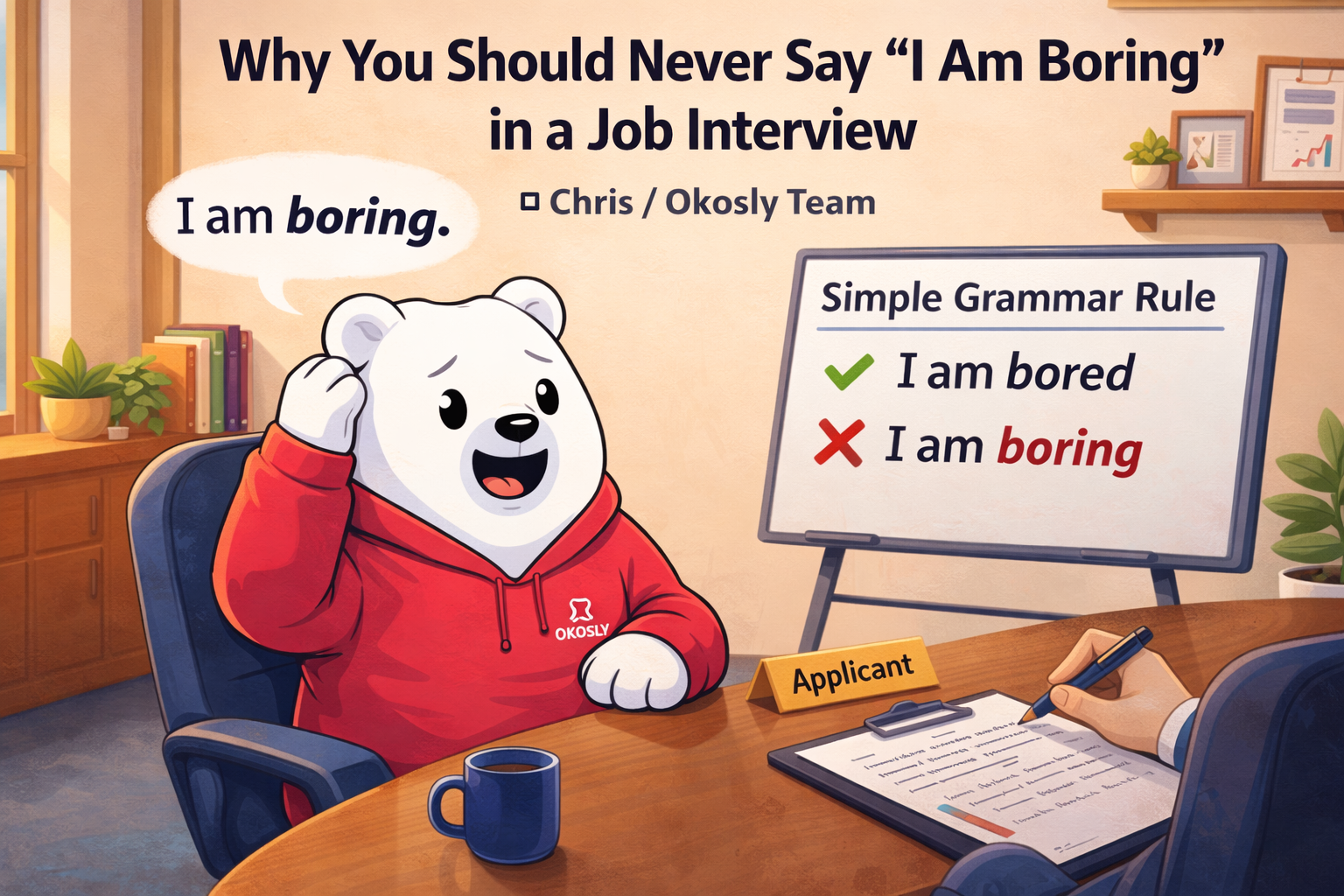
Why You Should Never Say "I Am Boring" in a Job Interview
The -ed vs -ing adjective mistake is the most common error in IELTS speaking tests and work emails. Two letters change whether you're the source of a feeling or the person catching it. Here's the simple rule that fixes it forever.
By Chris S · · GrammarYou're in a job interview. The interviewer asks how you feel about the role. You smile and say, "I'm very exciting about this opportunity."
You just told them you excite other people. You meant you feel excitement. The interviewer noticed. They didn't say anything. They moved on. But it stuck.
This is the single most common adjective mistake B1 to C1 English learners make, and it happens in interviews, emails, IELTS speaking tests, and first-day introductions. The good news: the rule behind it is shorter than the mistake itself. Two letters change whether you're the source of a feeling or the person catching it.
If you've ever said "I am bored" when you meant "I am boring" (or the other way round), this post is for you.
The Rule, in One Line
-ing describes the source of the feeling. -ed describes the person feeling it.
The film is boring. It sends boredom into the room. You are bored. You catch the boredom the film sent.
That's it. No tenses. No participles. No grammar terminology. Just direction.
A native speaker doesn't think "I need the present participle here." They think "is this feeling coming from me or coming at me?" If you can answer that question, you can pick the right ending every single time.
The Three Sentences That Catch Almost Everyone
"I am bored" vs "I am boring"
❌ I am boring → You bore other people. You are the dull one in the room.
✅ I am bored → You feel boredom. Something in the room is dull.
If a colleague asks how the meeting is going and you say "I am boring," you just told them you're the problem.
"I am excited" vs "I am exciting"
❌ I am exciting about the new job → You excite other people about the job. Slightly arrogant, very weird.
✅ I am excited about the new job → You feel excitement. Normal.
This one shows up constantly in onboarding emails. "I'm exciting to join the team" is one of the most common errors hiring managers see from non-native speakers.
"I am confused" vs "I am confusing"
❌ I am confusing about the deadline → You cause confusion in others about the deadline. Strange.
✅ I am confused about the deadline → You don't understand the deadline. Honest and clear.
This is the Slack message classic. If you're asking your manager for clarification and you write "I'm confusing about Friday's deliverable," you've accidentally told them you're the source of the problem.
Why Your First Language Makes This Hard
Most languages don't split these two ideas the way English does. In Spanish, "estoy aburrido" covers both "I am bored" and (in casual speech) "I am boring." In Turkish, the same suffix handles both feelings. In Vietnamese, there's no adjective inflection at all.
So when you learn English, your brain looks for one word per feeling. English gives you two and forces you to choose. The choice is direction: who's sending the feeling, and who's catching it.
Once you see that, the rule is automatic.
Common Mistakes Section
Mixing the two in one sentence
❌ "I am bored, the film was bored."
✅ "I am bored, the film was boring."
The film sent the feeling. You caught it. Different words.
Using "interested" as if it means "interesting"
❌ "She is a very interested person."
✅ "She is a very interesting person."
She is the source of interest (she's fascinating). You'd say "I am interested in her" to describe yourself catching it.
Using "tiring" for yourself
❌ "I am tiring after the trip."
✅ "I am tired after the trip."
"Tiring" would mean you exhaust other people. The trip is tiring. You are tired.
The "in" trap
❌ "I am interesting in your project."
✅ "I am interested in your project."
This is the single most common version of this error in professional emails. If you remember nothing else, remember: "interested in" is the phrase you want when describing yourself.
Try These Three
Fill in the blank. Answers at the bottom.
The instructions were really __________. (confusing / confused)
I'm __________ about the test tomorrow. (worrying / worried)
That documentary was __________. I learned so much. (fascinating / fascinated)
Answers: confusing, worried, fascinating.
Frequently Asked Questions
Is "I am bored" rude?
No. It just means you feel boredom right now. It's a normal thing to say. "I am boring," on the other hand, is a self-criticism — you're saying you are the dull person.
Can a person be "interesting" or "interested"?
Both, but they mean opposite things. "She is interesting" means she fascinates others. "She is interested" means she pays attention to something. You can be both at once.
Why does English do this when other languages don't?
English borrowed and built up these adjectives from verbs over centuries, and the -ing and -ed forms kept their original directional meaning — one for the actor, one for the receiver. Other languages flattened the distinction. English never did.
Is this on the IELTS speaking test?
Yes, constantly. Examiners hear "I was very boring during the holiday" multiple times a day. Getting this right is one of the fastest ways to lift your Band 6 speaking response to a Band 7.
One Last Thing
If you only remember one rule from this post: -ing is the sender. -ed is the catcher. The film sends boredom; you catch it. The job sends excitement; you catch it. The deadline sends confusion; you catch it.
Once you see that direction, you'll never get it wrong again.
Want a tutor who can spot mistakes like this in real time? Find an English tutor on Okosly →