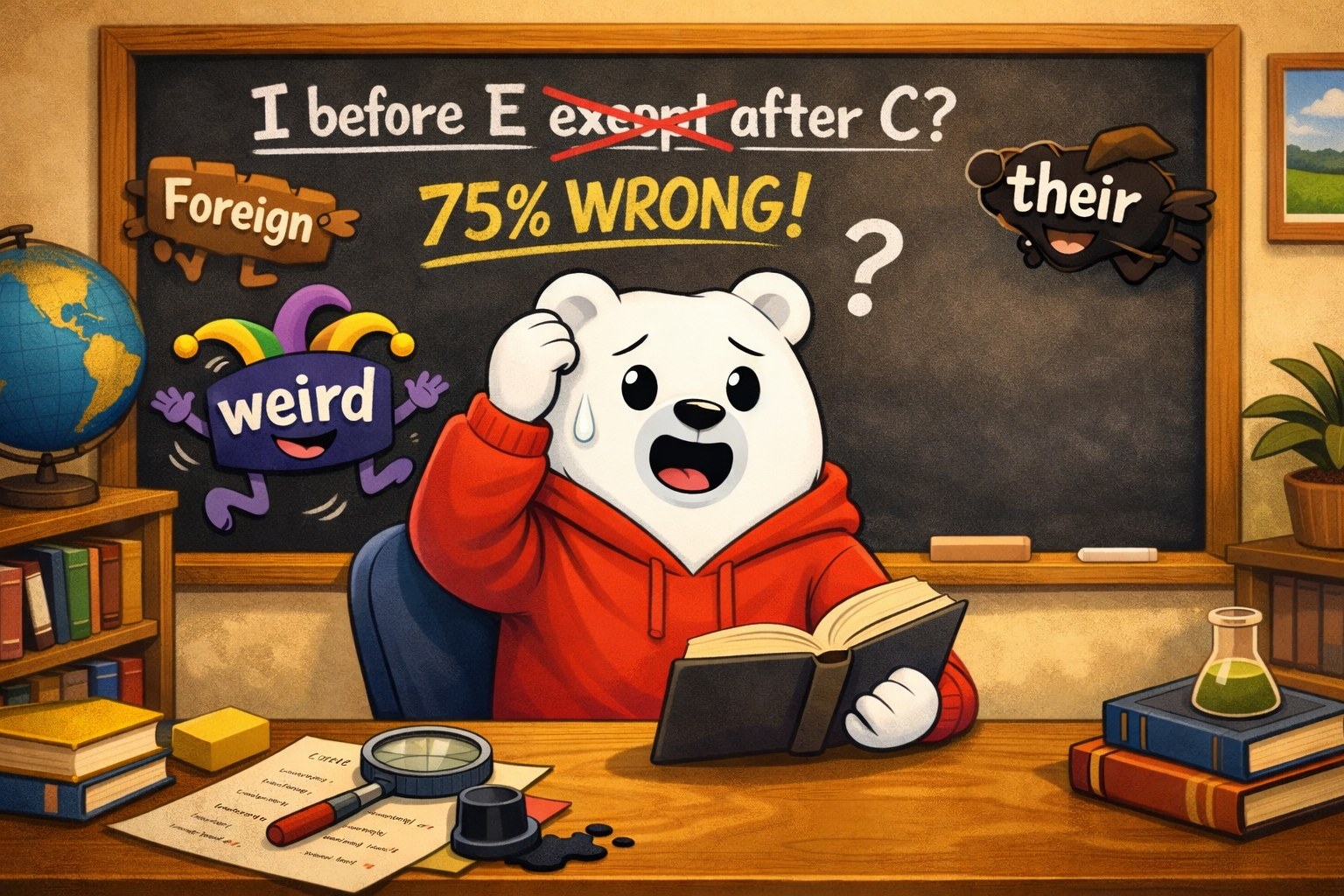
The "I Before E" Lie: Why the Famous Spelling Rule is Wrong 75% of the Time
You were likely taught "i before e, except after c" at school. But with words like science, weird, and their, the famous rule actually fails most of the time. Here is why it breaks down, and the simple trick you should memorise instead.
By Chris S · · Grammar"I Before E Except After C" Is Wrong Most of the Time. Here's What Actually Works.
You learned it as a clean rule: i before e, except after c. So why does weird break it? And their? And science, which puts "ie" right after a c, the exact opposite of what the rule promised? If you're writing an IELTS essay or a work email and second-guessing every "ei" pair, you are not the problem. The rule is. This is for anyone who keeps getting flagged by spellcheck on words they were sure they had right.
The rule only ever worked for one sound
Here is the part that almost never gets taught. The rhyme was only ever meant for words where the "ie/ei" pair sounds like "ee" — believe, piece, field, receive. The moment the sound changes, the rule has nothing to say. Their sounds like "air." Height sounds like "hite." Weird sounds like "weerd" but comes from an old English word that never followed the pattern in the first place. So most of the words that "break" the rule were never inside it to begin with.
Even where it should work, the "after c" half collapses
A statistician at the University of Warwick, Nathan Cunningham, decided to test it properly. He ran the rule against a list of 350,000 English words. The "i before e" half held up reasonably well — across the language, "ie" beats "ei" by about three to one. Good odds. But the "except after c" half is where it falls apart. He found that even after a c, "ie" still wins by roughly three to one. For every receive there is a science, an ancient, a society, a sufficient. So the famous exception is wrong about 75% of the time. The thing you were told to watch out for is the thing that fails most.
The rule is also old. It shows up in a spelling manual from 1866 and has been passed down ever since because it rhymes, not because it's accurate. In 2009 the UK government's own spelling guidance told primary teachers to stop teaching it, saying flatly that it isn't worth teaching because there are too many exceptions.
Common mistakes
weird, their, foreign
These have no c anywhere, and they don't make an "ee" sound, so the rule simply does not apply. Stop trying to force them through it. Learn them as their own small set: weird, their, foreign, height, seize, leisure.
receive vs believe
This is the pair that actually follows the rule, and learners still miss it because they're spelling by sound. believe = ie, no c. receive = ei, after c. If you only memorise four "ei after c" words — receive, deceive, perceive, ceiling — you've covered most of the real cases.
science, ancient, society
These are the rule's worst enemy: "ie" sitting right after a c. The reason is the sound. The c here makes a "sh" or "s" sound and the i and e land in separate syllables. The rule was never built for them, so they look like exceptions but they're just outside its job.
Practice prompts
Write five sentences, one each using receive, believe, weird, their, science. Read them out loud. Notice that only receive and believe make the "ee" sound — those are the only two the rule was ever talking about. Then try spelling these from memory: foreign, height, niece, protein, leisure. Check them. The ones you missed are your personal list to drill.
FAQ
Is "i before e except after c" a real rule? Sort of. It works for "ee"-sound words with no c, but the "except after c" part is wrong most of the time, so it's better treated as a loose hint than a rule.
Why is "weird" spelled that way? Because it doesn't make an "ee" sound and comes from old English, it was never inside the rule. It's "ei" with no c — a clean break.
Why does "science" have "ie" after c? The c makes a soft sound and the i and e fall in different syllables. The rule only targets the "ee" sound, so science sits outside it.
What's the easiest fix? Memorise the short list of true "ei after c" words — receive, deceive, perceive, ceiling — and treat everything else as something to learn word by word.
Did the UK really stop teaching it? Yes. In 2009 official government spelling guidance advised teachers it wasn't worth teaching.
Spelling rules like this are easier to fix with someone watching you write in real time. Okosly connects you with English tutors for one-on-one lessons that target the exact words tripping you up. Find a tutor →
Spelling rules are much easier to navigate with an expert by your side. Why not learn from one of our professionals here?