Why You Can't Say "Informations" (Countable vs Uncountable Nouns)
"Informations" is the most common plural mistake in English. Here's why English won't count it, the simple fix, and a quiz to test yourself.
By Chris S · · WritingWhy You Can't Say "Informations" (Countable vs Uncountable Nouns)
You wrote "I need some informations" and it felt completely correct. In your language it probably is correct. Then a teacher, a colleague or an autocorrect underlined it in red, and nobody fully explained why. This post is for anyone learning English who keeps adding an "s" to words that refuse to take one. The good news is that this is not a sign your English is weak. It is one of the most common mistakes in the world, and once you see the logic behind it, you stop making it for good.
The mistake almost everyone makes
This is not a rare error. Cambridge keeps a huge database of real exam scripts called the Cambridge Learner Corpus, built up over about twenty years, where language specialists tag every mistake learners make. When they looked at countability errors, "information" came out as the single most common word that learners wrongly make plural, with "advice" close behind. Almost all of these errors go in one direction: learners add a plural to a word that does not take one, rather than the other way around.
There is a clear reason for that, and it has nothing to do with effort. In French, Italian, Spanish, Polish, German and Portuguese, the word for information is countable and has a normal plural. So speakers of those languages, which is a huge slice of learners worldwide, carry that plural straight into English without thinking. The error feels natural because in your first language it genuinely is correct.
Think of it like water, not apples
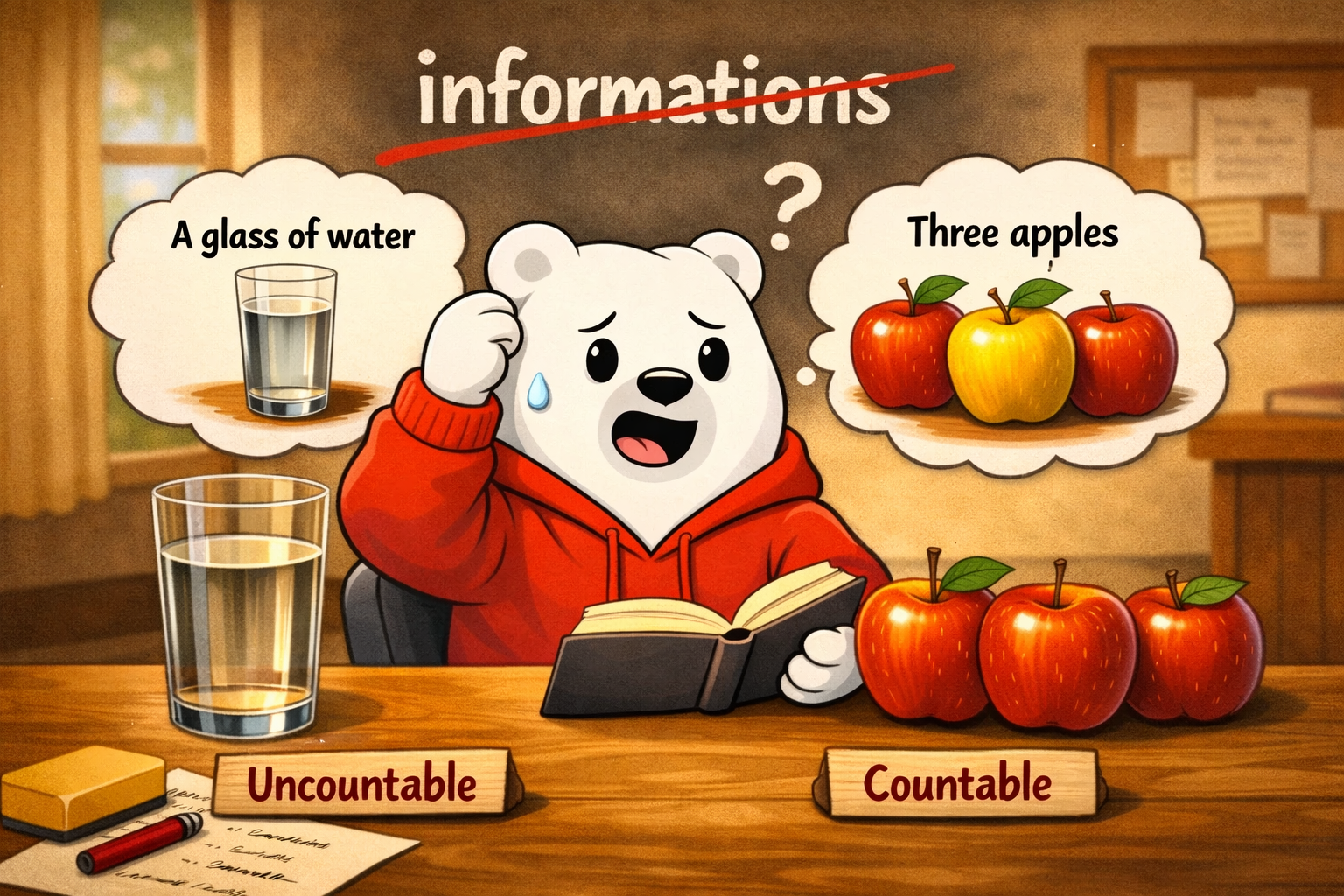
Here is the mental model that fixes this permanently. English sorts nouns into two buckets. Some nouns are things you count, like apples. One apple, two apples, three apples. Others are things you measure, like water. You never ask a waiter for "two waters" in careful English. You ask for two glasses of water, or two bottles of water. The water itself stays singular. You count the container, not the water.
Information sits in the second bucket. To English, information is like water. You cannot break it into separate countable units, so you never say "one information" or "three informations." Instead you measure it. A piece of information. A bit of information. Some information. The word "information" never changes its shape. You simply place a measuring word in front of it when you need to count.
The beautiful part is that this one idea covers a whole group of words. Advice, furniture, luggage, equipment, homework, research and news all live in the water bucket. So you say a piece of advice, an item of furniture, two pieces of luggage, a lot of equipment. Learn the pattern once and you have fixed dozens of words at the same time.
The words that catch everyone out
A few of these words are worth knowing by name, because they cause trouble again and again.
Information
The number one offender. Never "informations," never "an information." Use some information, a piece of information, or a lot of information.
Advice
Right behind information. Not "advices." If your friend gives you three useful tips, that is three pieces of advice, or simply some good advice.
Luggage and furniture
These feel countable because you can see separate bags and separate chairs. English does not care. It is two pieces of luggage and three pieces of furniture, never "luggages" or "furnitures."
News
This one is sneaky because it ends in "s" and looks plural. It is not. The news is good, not "the news are good." If you need one item, it is a piece of news.
The full list of uncountables that trip people up
Here are the words learners most often turn plural by mistake. None of these take an "s," and none take "a" or "an" on their own. When you need to count them, reach for a measure word like "a piece of," "a bit of," "an item of," or just "some."
Ideas and study: information, advice, knowledge, progress, research, evidence, proof, feedback, vocabulary, grammar, education
Around the house and travel: furniture, equipment, luggage, baggage, accommodation, scenery, traffic, rubbish
Work and daily life: homework, work, money, news, fun, help, behaviour, health, weather, music
Food and substances: water, bread, rice, sugar, salt, butter, cheese, coffee, meat
A quick way to count any of them: a piece of information, a bit of advice, an item of furniture, two pieces of luggage, a lot of equipment, a slice of bread, a grain of rice, a glass of water. The noun in the middle never changes shape.
How to practise this
Reading the rule is not enough. You fix this by producing the correct form out loud until the wrong one starts to sound strange. Try saying these three sentences now: "I have some good news." "Can I give you a piece of advice?" "I packed two pieces of luggage." Then take five uncountable nouns from this post and build your own sentence for each, using "some," "a piece of," or "a lot of." When you write emails this week, slow down on the words information, advice and equipment, and check that none of them ended up with an "s." A few days of that habit and the mistake disappears.
Quick quiz: spot the mistake
Each sentence below has one countability error. Fix it, then check your answers underneath. No peeking.
I need some informations about the course.
He gave me three advices before the interview.
We bought two new furnitures for the office.
I have too many homeworks tonight.
The news are very good today.
She did a lot of researches for her report.
How many luggages can I bring on the flight?
Can you send me some feedbacks on my email?
Answers
I need some information about the course.
He gave me three pieces of advice before the interview.
We bought two new pieces of furniture (or some new furniture) for the office.
I have too much homework tonight.
The news is very good today.
She did a lot of research for her report.
How much luggage (or how many bags) can I bring on the flight?
Can you send me some feedback on my email?
If you missed any, the word you tripped on is one to add to your sight list and drill this week.
FAQ
Is "informations" ever correct in English?
Not in everyday or business English. It exists only as a narrow legal term in some countries, which is unrelated to how you mean it. For normal use, always treat information as uncountable.
How do I count an uncountable noun?
Put a measuring word in front of it. A piece of information, a bit of advice, an item of furniture, two glasses of water. The noun stays singular and you count the container or unit instead.
Why does my language let me say it but English does not?
Many languages, including French, Italian, Spanish and Polish, treat these words as countable. English simply sorted them into its uncountable bucket. It is a difference between languages, not a mistake in your thinking.
Do I use "much" or "many" with these words?
Use "much" and "a lot of" with uncountable nouns: much information, a lot of advice. "Many" is only for countable nouns: many books, many people.
Does the verb change too?
Yes. Uncountable nouns take a singular verb. The information is helpful. The news is good. Never "are" in these cases.
Keep going
Countability is one of those areas where a single clear explanation saves you years of small mistakes. If you want someone to catch these patterns in your own speaking and writing and fix them as you go, that is exactly what a tutor is for, and what Okosly is built around. So now you have the information. Just don't add an "s" to it.
Spelling rules are much easier to navigate with an expert by your side. Why not learn from one of our professionals here?